


Pump Repair Method Using Belzona Composite Materials
Process media can cause corrosion, erosion and other forms of damage to pump components, leading to deterioration and reduced efficiency. Instead of replacing pump parts, composite repair materials and protective coatings can offer a more sustainable solution for pump repair.
Step-by-Step Guide on Pump Repair with Belzona
This blog post explains how to repair a pump with Belzona using a cold-applied material and a coating grade designed to provide long-term protection and improve pump efficiency. The repair system combines Belzona 1111 (Super Metal) for pitting repairs and Belzona 1341 (Supermetalglide)as a protective coating to help improve its efficiency and prevent further deterioration.
Step 1: Prepare the Surface
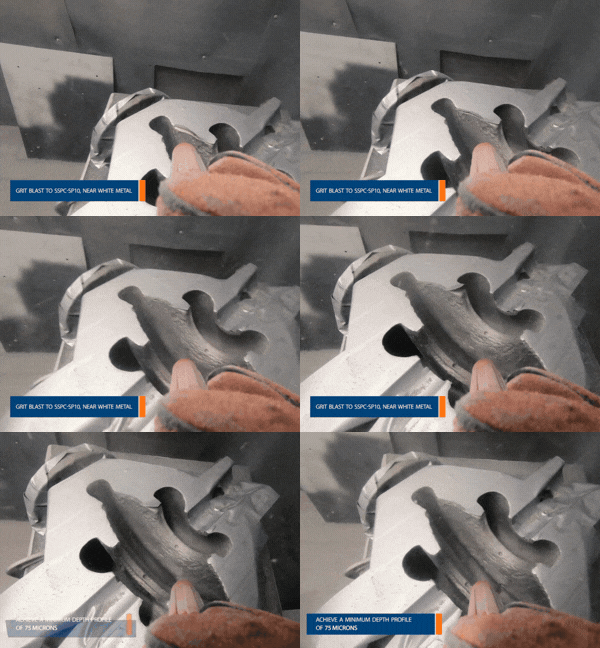
Apply duct tape to cover the areas outside of the target repair. Then, roughen surfaces by blast cleaning, deeply scoring, or grinding to achieve the requirements of SSPC-SP10, near-white metal with a minimum depth profile of 3 mils (75 microns).
Step 2: Define the Repair Area
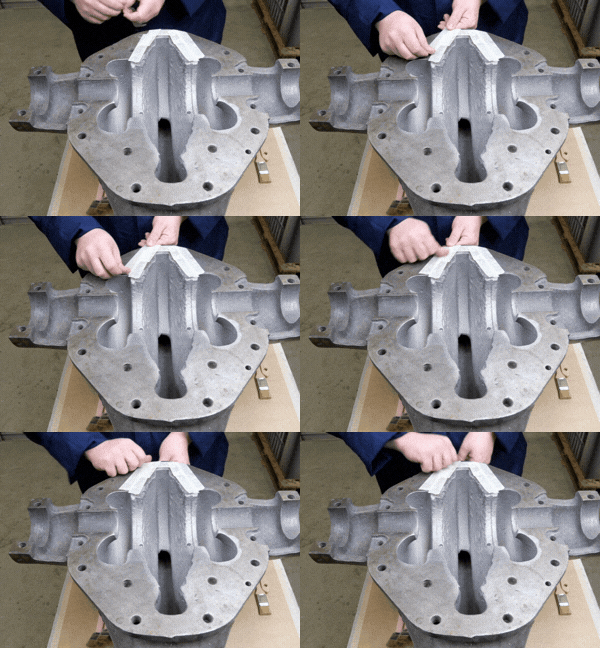
Apply the masking tape on the pump to define the repair area. This step ensures a neat, clean finish of the pump repair.
Step 3: Mix Belzona 1111 (Super Metal)
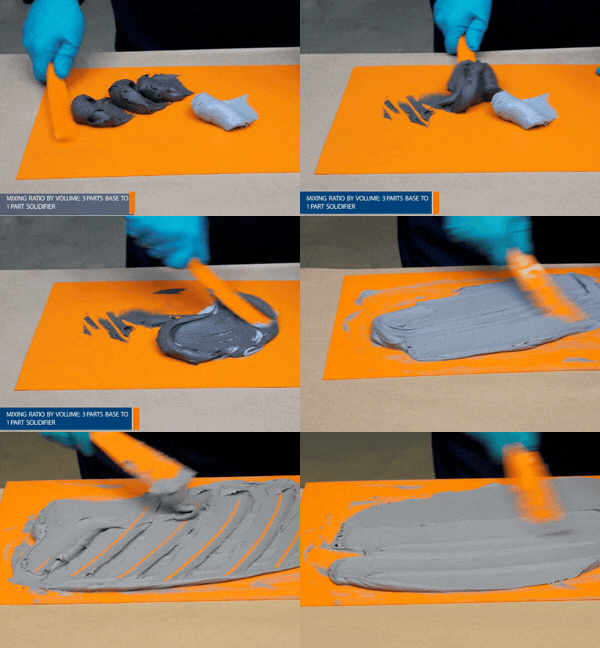
Start mixing Belzona 1111 (Super Metal) by volume, using three parts Base and one part Solidifier by volume. Mix thoroughly to achieve a uniform color.
Step 4: Apply Belzona 1111 (Super Metal) on the Prepared Surface
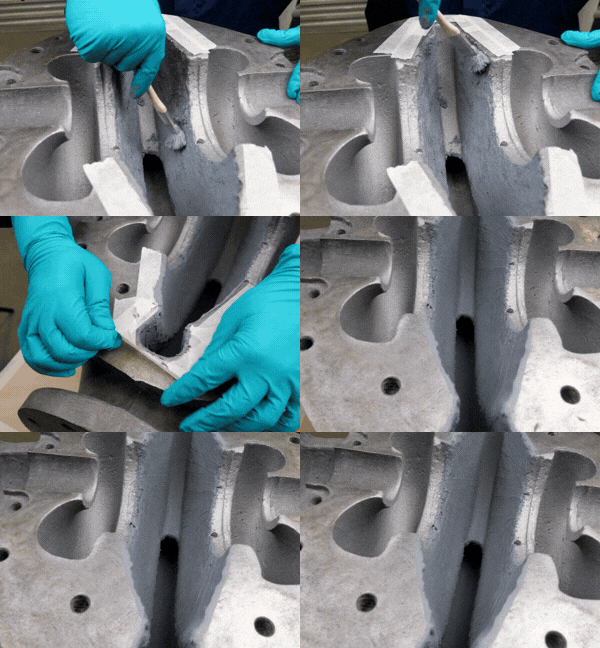
Use a bristle brush to apply the mixed materials, forcing down into the surface firmly to avoid air entrapment. Ensure all pitted areas are completely filled.
Step 5: Sealing Ring Seat Repair
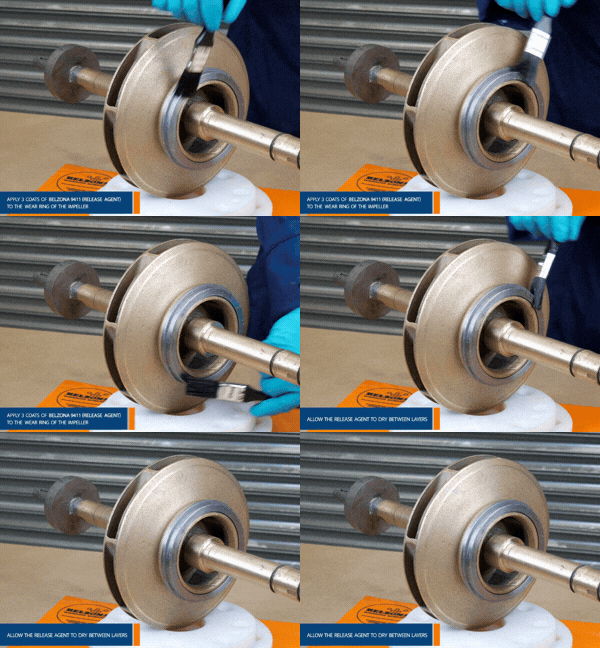
Apply three coats of Belzona 9411 (Release Agent) to the wear ring of the impeller. Allow each layer to dry before application of further layers. This step is required to form the shape on the wear ring seat and to allow the removal of the impeller after Belzona 1111 (Super Metal) is cured.
Step 6: Mix Belzona 1111 (Super Metal) for the Ring Seat and the Impeller Ring
Mix Belzona 1111 (Super Metal), using three parts Base and one part Solidifier by volume and mix thoroughly to achieve a uniform color.
Step 7: Form the Wear Ring Seat with Belzona 1111 (Super Metal)
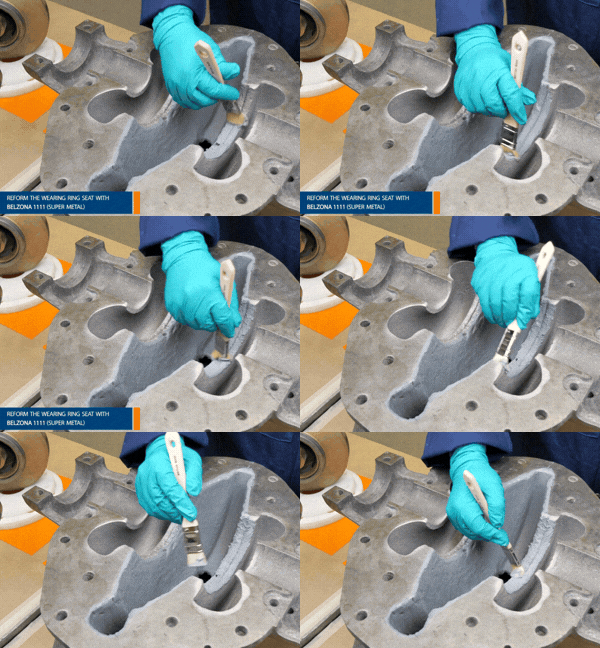
Use a short bristle brush to apply Belzona 1111 (Super Metal) to the ring seat. Start by wetting out the prepared surface with a thin layer and pushing it hard into the profile using the brush.
Step 8: Apply Belzona 1111 (Super Metal) to the Impeller Wear Ring
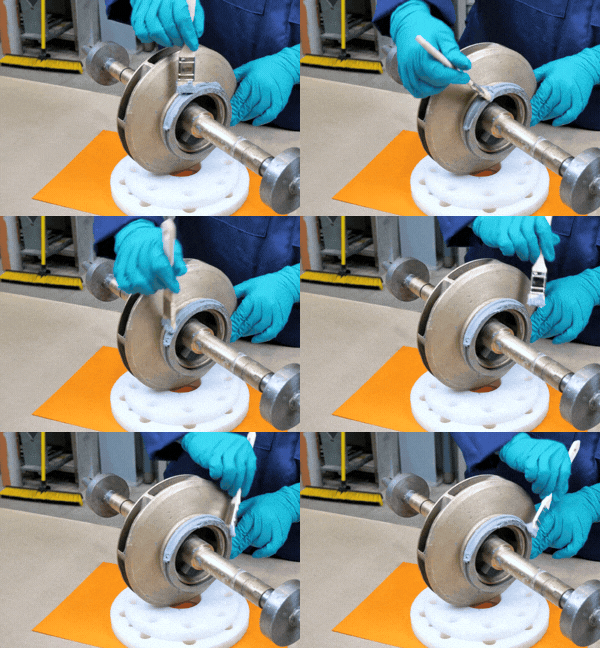
Apply Belzona 1111 (Super Metal) to the wear ring of the impeller, previously coated with Belzona 9411 (Release Agent).
Step 9: Form a Peak with Belzona 1111 (Super Metal)
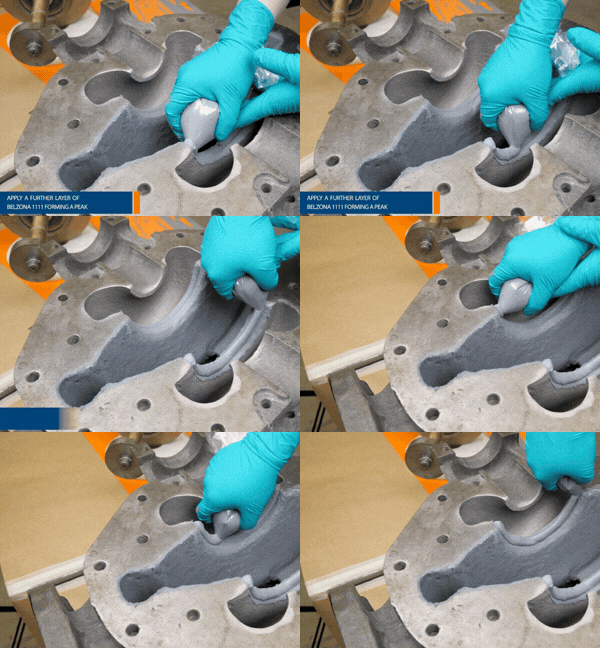
Apply a further layer of Belzona 1111 (Super Metal) onto the wear ring seat. Alternatively, use a piping bag to facilitate the application of the product onto the wear ring seat. Allow the material to form a peak along the center line.
Step 10: Lower the Rotating Element into Place
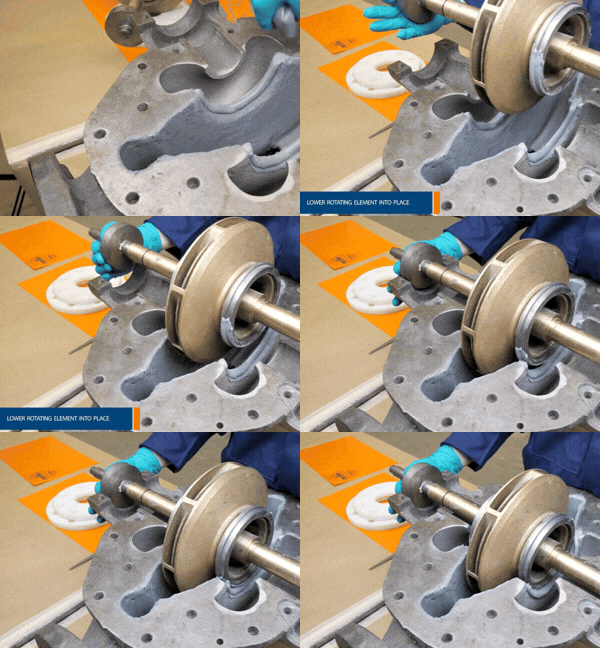
Lower the rotating element into position. The material on the wear ring will conform to the shape of the pump body. Then, remove any excess material from the pump parts.
Step 11: Remove the Former and Dress the Repair
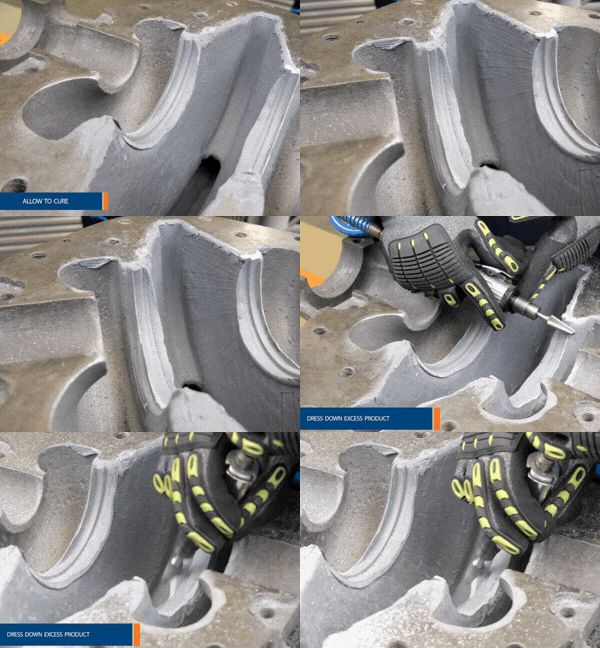
Allow the Belzona material to fully cure before removing the formers and dressing the repair.
This method is applicable to split case pump repair, pump impeller repair, end suction water pump repair, and any other pump parts that require pit filling prior to coating for preventing further degradation.
Addition of Belzona 1341 (Supermetalglide) Coating to Enhance Pump Efficiency
To further protect the pump components and improve energy efficiency, Belzona recommends applying a protective coating such as Belzona 1341 (Supermetalglide). The material’s hydrophobic properties help reduce internal friction losses, enhancing pump performance.
Step 1: Mix Belzona 1341 (Supermetalglide)
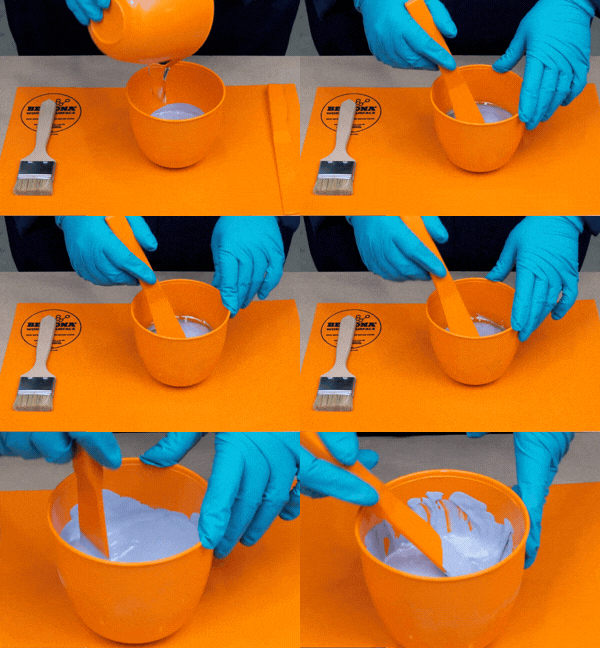
Start mixing Belzona 1341 (Supermetalglide), using 1:1 ratio of Base to Solidifier by volume. Combine the Base and Solidifier to achieve a uniform color, free of any streakiness.
Step 2: Apply the First Coat of Belzona 1341 (Supermetalglide)
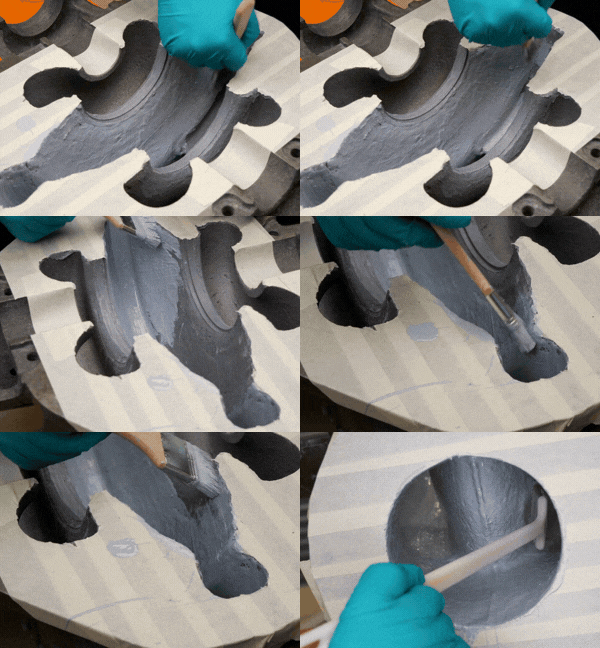
Apply Belzona 1341 (Supermetalglide) using a short-bristled brush. Use a long-handled brush for areas that are difficult to access.
Step 3: Mix Belzona 1341 (Supermetalglide) for the Second Coat
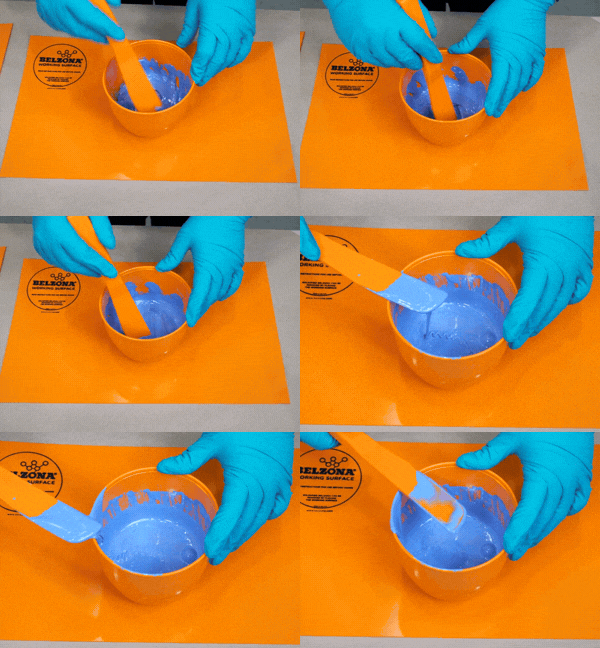
Within the overcoat window, prepare for the application of the second coat. Mix Belzona 1341 (Supermetalglide) using the same 1:1 ratio of Base to Solidifier by volume.
Belzona 1341 (Supermetalglide) is available in two colors, grey and blue. Belzona recommends using contrasting colors for the two-coat application. Using contrasting colours also supports quality control, making it easier to visually confirm that the second coat has been applied correctly. Missed spots or thin areas in the topcoat will reveal the first coat color underneath, alerting inspectors or applicators to recoat those areas.
Step 4: Apply the Second Coat of Belzona 1341 (Supermetalglide)
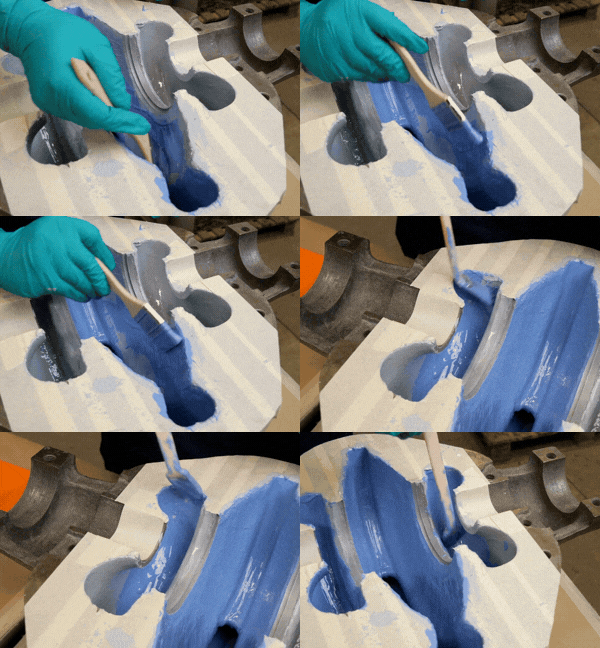
Repeat the same application method, using a short-bristled brush to apply the second coat of Belzona 1341 (Supermetalglide).
Allow the product to cure in accordance with the manufacturer’s Instructions for Use.
Full Video Explains How to Repair a Pump
Proven Pump Repair Solutions for Energy and Cost Saving
A test was conducted to evaluate the effect of Belzona 1341 (Supermetalglide) on pump efficiency. The results showed that lining the internal surfaces of an end-suction pump with Belzona 1341 (Supermetalglide) improved all tested parameters.
|
Test Condition/Incremental |
Hydraulic Efficiency (%) |
Flow Rate (L/s) |
Differential Head (m) |
|
Not lined |
32.6 |
72.9 |
61.7 |
|
Lined with Belzona 1341 (Supermetalglide) |
40.7 |
114.6 |
129.1 |
|
Incremental |
8.1 percentage points |
41.7 L/s |
67.4 |
Recent pump repair applications demonstrate potential cost and energy savings in industrial operations.
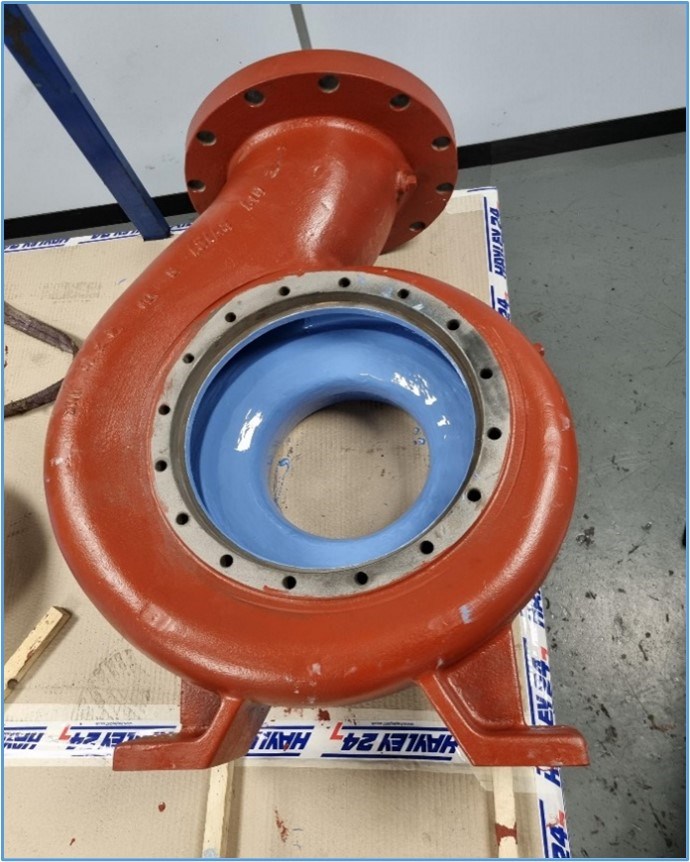
- End-section pump repair in an automotive manufacturing facility: By using Belzona 1111 (Super Metal) for rebuilding the casing and the stuffing box and Belzona 1341 (Supermetalglide), the automotive manufacturer expects annual energy savings to reach £14,500 per pump.
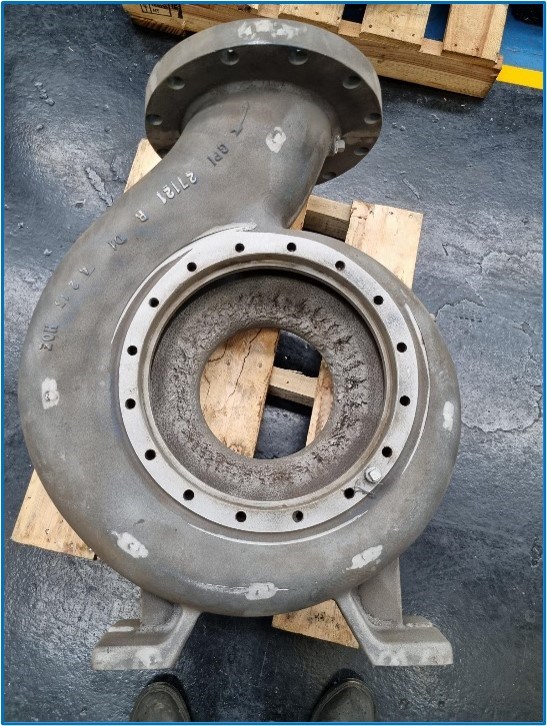
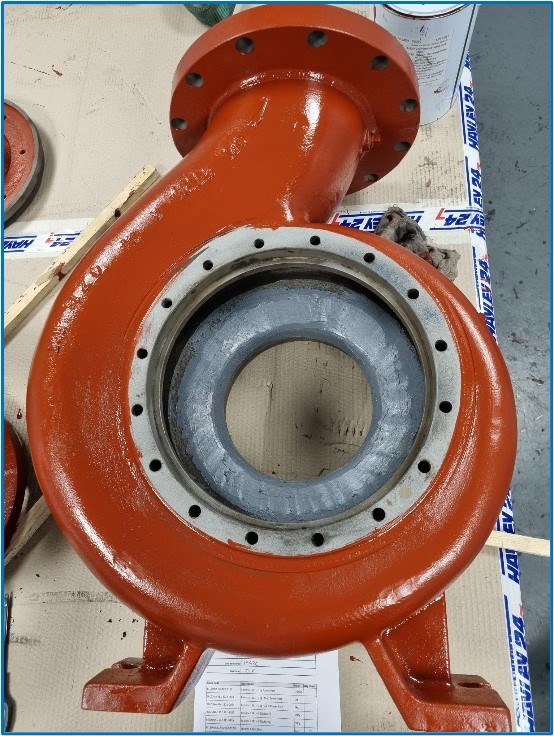
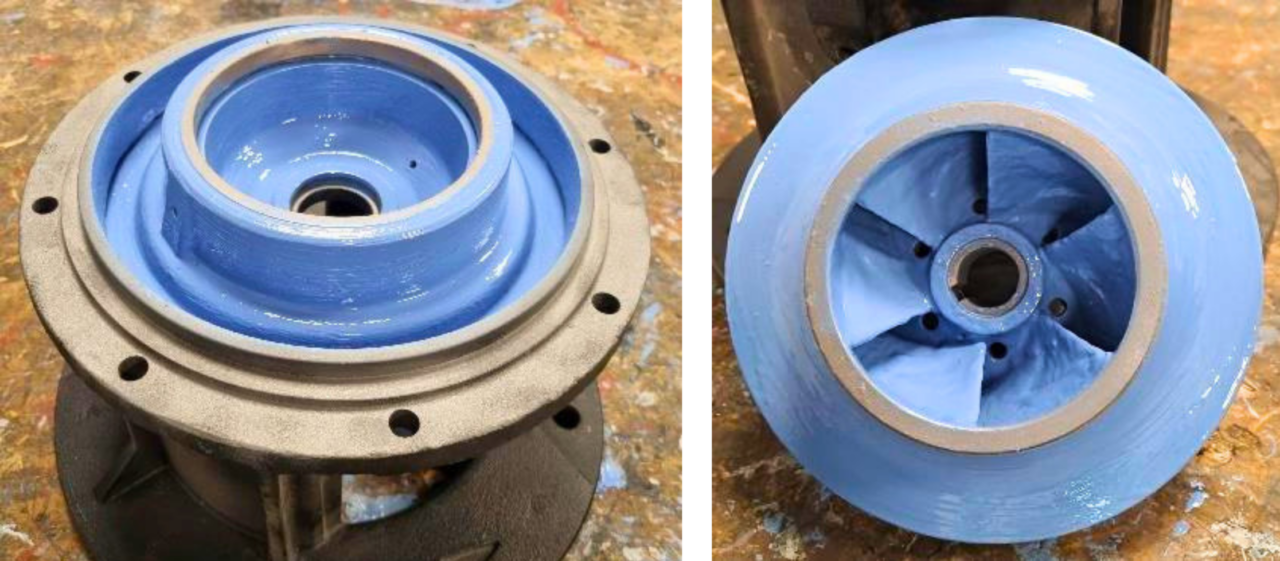
- Impeller inlet vanes on a chiller system: By using Belzona 1111 (Super Metal) for rebuilding and Belzona 1341 (Supermetalglide) to protect the casing and stuffing box, the refurbished impeller is expected to achieve an increase in hydraulic efficiency. This improved efficiency is expected to deliver annual energy savings of £3,188, while also helping to extend the service life of the chiller system.
Learn More
How to Repair and Protect Sea Water Pumps (with GIFs)
How to Apply a Pump Coating – Belzona Blog
Frequently Asked Questions
What is a recommended method for centrifugal pump repair?
Centrifugal pumps usually suffer erosion and corrosion due to handling process water. Instead of replacing the pumps, which can be costly and time-consuming, industries can apply epoxy-based materials to rebuild the pump surfaces. To start the repair, Belzona recommends removing old coatings and any contamination using an abrasive blasting method or other appropriate cleaning methods to achieve target surface cleanliness.
Once the surface preparation is done, Belzona 1111 (Super Metal) or any other appropriate rebuilding materials can then be applied to restore the surface profiles. Then, Belzona recommends applying a two-coat protective coating such as Belzona 1381 or Belzona 1341 (Supermetalglide) to safeguard the pump surface from further deterioration.
What epoxy metal repair can restore worn pump shafts?
A range of rebuilding compounds for metal repair can be applied on pump shafts without the need for hot work, providing a practical solution for restoring damaged metal surfaces. The most suitable epoxy-based material for metal repair depends on several factors, including the type and extent of damage, the shaft dimensions, the installation environment, and the repair timeframe. Shaft repairs without welding can be carried out using the following methods:
- Shaft Repair Using Injection
- Shaft Repair Using Forming Technique
- Shaft Keyway Repair
What are suitable repair methods for slurry pumps?
Slurry pumps are heavy-duty pumps that process a mixture of liquid and solid particles. They are commonly used in mining operations as well as oil extraction processes. These conditions create a highly abrasive and corrosive operating environment. An appropriate repair method involves rebuilding and reprofiling the damaged pump surfaces before applying a protective coating.
For example, Belzona recommends using Belzona 1311 (Ceramic R-Metal) to rebuild and restore damaged areas to their original profile followed by Belzona 1321 (Ceramic S-Metal) as a protective coating to help prevent further deterioration. Belzona 1321 (Ceramic S-Metal) can also serve as a bonding agent for the installation of Belzona 9811 (Alumina Tiles), providing additional protection against abrasion. Belzona 9811 (Alumina Tiles) can be installed in conjunction with Belzona 1812 (Ceramic Carbide FP), Belzona 1813, or Belzona 1814 as grouting materials. The selection of repair and protection system should be based on the operating conditions of the pumps. For more information, contact a Belzona Authorised Distributor.
How can I calculate materials required for a pump repair using Belzona rebuilding materials and protective coatings?
Information about the volume capacity and coverage rate is available on the Product Specification Sheet and the Instructions for Use. The required quantity of material can be calculated based on the size and dimensions of the target repair and the product’s coverage rate or volume capacity.
Source : https://blog.belzona.com/

P.T. Tunas Tasik was established in 1960 as a general trading company. In 1982 the company concentrated its business in the field of Industrial Maintenance and Repair when it acquired the sole agency for the Belzona range of high performance polymers from Belzona Polymerics Ltd. UK.

© 2024 PT. Tunas Tasik - All Rights Reserved
Comments (0)